Al Jazara
روایت خاورمیانه
Al Jazara
روایت خاورمیانه 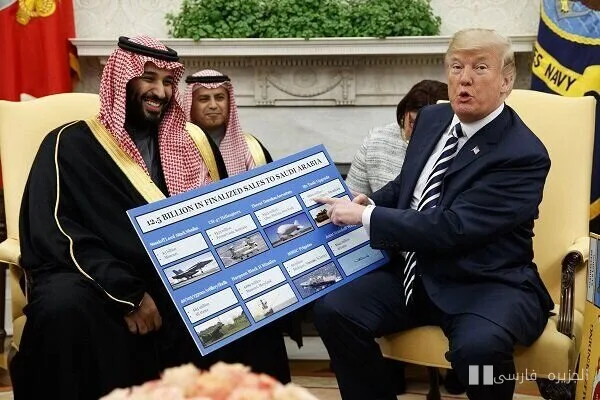
Mohammed bin Salman, the Crown Prince of Saudi Arabia, has called for airstrikes against the positions of Yemen's Ansar Allah in two urgent phone calls with Donald Trump, the President of the United States. These requests came in response to the advance of Houthi forces towards the coastal city of Mokha and their proximity to the strategic Bab al-Mandab Strait. Trump rejected both requests and stated that Washington currently has no plans for direct military intervention and is only providing targeting information and data to the Saudis.
Presence of American Forces in Saudi Arabia
Currently, about 200 American forces are present in Saudi Arabia, playing a non-combat advisory role. This occurs as the conflicts in Yemen have intensified and Ansar Allah has gained more control over vital trade and oil export routes. In this situation, Saudi Arabia is in dire need of military and security support from the U.S., but Washington's negative response indicates instability in the security agreements between the two countries.
Read more: Multiple Explosions on Qeshm Island, Iran
Lessons from Iran's Experiences
This situation once again demonstrates that security agreements and collaborations with the U.S. cannot guarantee stability and security. Iran's experience in facing external threats, especially in recent wars, shows that indigenous defensive power and reliance on domestic capabilities can serve as an effective strategy. The twelve-day war in Khordad 1404 and the forty-day war in Esfand of last year and Farvardin of this year are examples of this indigenous deterrent power that allowed the country to withstand attacks.
In fact, if Iran's defensive capabilities were dependent on agreements and external support, none of these countries would come to help in a crisis. Iran's indigenous deterrent and defensive power, which includes air defense systems, ballistic and cruise missiles, and drones, has managed to maintain the country's security.
The Necessity of Indigenous Power and Security Independence
Iran's experiences remind us that sustainable security can only be guaranteed when it is formed from within the nation and emphasizes indigenous capabilities. International cooperation agreements and treaties cannot replace national will and independent defensive power. The U.S., as a global power, adjusts its treaties based on momentary interests, and for this reason, countries that tie their security to these treaties face a support vacuum in crisis situations.
Ultimately, Iran's model shows that investing in indigenous defensive capabilities and relying on human resources and national will is the only way to create real deterrence. Security is not imported, and it can only be achieved through internal strength and independence.
Read more: The Israeli Army Avoided Attacking Yemen · Israeli and Saudi Intelligence Cooperation to Counter the Houthis