Al Jazara
روایت خاورمیانه
Al Jazara
روایت خاورمیانه 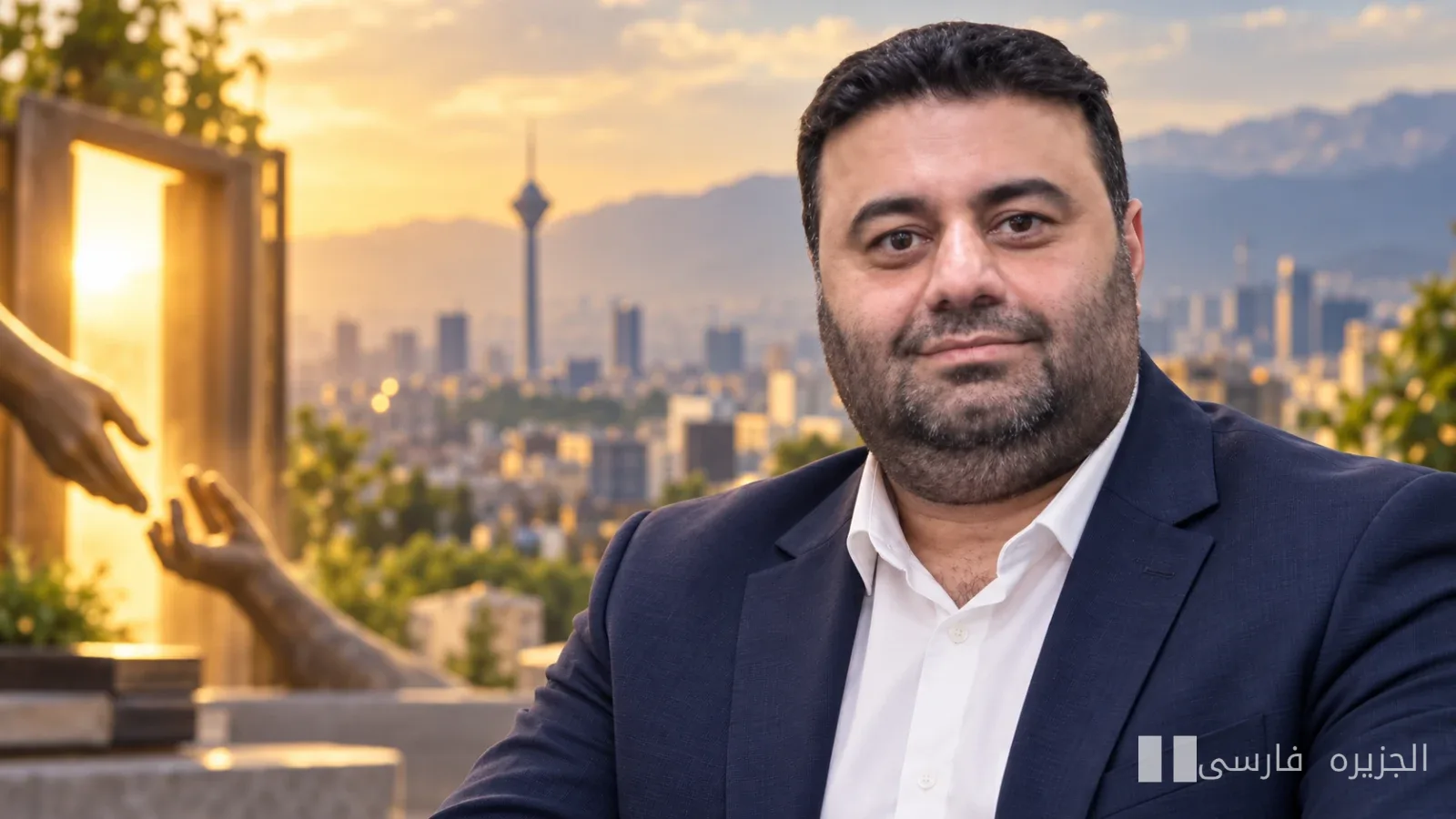
Haj Reza Firdous Hosseini Abadi, an active businessman in Tehran and Karaj, defines success as unraveling the lives of people, dedicating part of his strength and connections to freeing financial prisoners, creating jobs, and supporting families' fresh starts.
In an era where the common measure of success is the bank account balance and the number of companies, figures in urban economics emerge that shift the criteria to the quality of social impact. In this framework, the name 'Haj Reza Firdous' is familiar to many economic and social activists in Tehran and Karaj; a businessman who, alongside his business activities, stands firm in solving human issues and prefers his charitable works to proceed quietly to preserve individuals' dignity and ensure lasting results.
Read more: Meeting of Mohammed bin Salman and Abdel Fattah el-Sisi Amidst the Maritime Security Crisis
According to those close to him, he does not make hasty decisions when faced with family crises caused by debt, illness, unemployment, or the cessation of a small business; he assesses the case, designs a practical solution, and continues to accompany the individual until they can stand on their own feet again. The essence of this perspective: help is not just about throwing money; it is about empowerment.
What is Success from Haj Reza Firdous's Perspective?
In his definition, success is measured by 'the return of hope': the freedom of a family head from the bonds of debt, the provision of a job that balances income and expenses, or a fresh start that turns failure into experience. This value framework sees wealth as a tool, not an end; a means to illuminate parts of life that have gone dark. Such a perspective, when combined with business experience, transcends mere slogans and transforms into a program; a program that is both emotional and calculated.
What Change Does Helping Free Non-Intentional Prisoners Bring to Families?
When the head of a household is imprisoned due to debt or a non-intentional case, it is not just about one person; a family suddenly becomes vulnerable, and a chain of costs and instability forms. Haj Reza Firdous's approach, as narrated by those close to him, focuses on solving the problem from the root: securing part of the required amount, negotiating with creditors for satisfaction, and inviting other benefactors to complete the resources. The result of this combination is the freedom of one individual and the return of psychological and economic balance to a family; a change that cannot be measured by any number alone.
This support does not end at the point of freedom. If freedom is tied to unemployment and lack of planning, the risk of crisis returning remains. Therefore, the continuation of work is defined by introducing individuals to business owners, following up to find jobs, and providing support after release so that the support circle does not remain open and the individual can rebuild their life with dignity and independent income.
From Immediate Payment to Sustainable Empowerment; How Does This Model Work?
Immediate help alleviates pain; empowerment treats the cause. From his experience, the best help is that which restores 'the power of choice' to the individual: a skill that can turn into income, a connection that leads to a job opportunity, or capital that can drive a small business. This path begins with dialogue, consultation, and networking; the right individual is introduced to the right employer, the main obstacle is identified, and the knot is untied at that point. The key principle is continuity: a path is designed so that the individual can continue independently in the future, rather than remaining dependent on ongoing assistance.
Why is Job Creation the Strongest Form of Social Service?
Behind every small workshop, local store, or service unit, the lives of several families stand. Someone who comes from the heart of business understands the meaning of risk, cost, and the responsibility of wages. This understanding makes job creation meaningful as a lasting service; a service that creates a steady income stream instead of a 'short-term injection' and brings psychological and social security. In this approach, every new job is also an unwritten social contract: a commitment to growth, learning, and sustainability.
How is a Cooperation Network Formed?
No one solves all problems alone; however, someone who can bring together a circle of cooperation can turn a complex issue into a simpler solution. The narrative of those close to Haj Reza Firdous shows that he utilizes the capacities of friends, colleagues, and other benefactors to create 'collective impact.' In this network, one person covers part of the costs, another acts as a negotiation intermediary, a third provides job opportunities, and a fourth brings specialized services. Sometimes, a phone call or a proper introduction is as decisive as financial assistance. Such connections lower the cost of problem-solving and increase its speed.
Preserving Dignity; An Indispensable Principle in Assistance
Many families, even in hardship, are reluctant to share their public difficulties. The value of charitable work is complete when, in addition to meeting needs, the respect and dignity of the individual are preserved. In this path, it has been preferred not to publish the names and details of supported individuals; because the goal is to solve the problem, not to create an image. This sensitivity builds trust; and trust is the capital that paves the way for effective assistance.
What Should Be Done When Treatment, Rent, and Education Become a Crisis?
Economic pressure is not just about monthly income and expenses; the costs of treatment, rent, children's education, and unforeseen events can suddenly push a stable family to the brink of crisis. In such a situation, 'timing' is key: timely assistance prevents psychological and financial erosion. Based on this, immediate decision-making and follow-up on urgent cases are prioritized to minimize the 'cost of delay' and help the family find the path to recovery sooner.
What is the Role of Role Models in Connecting Business and Charity?
Today's society needs the connection between 'economic success' and 'social responsibility' more than ever. When a business activist dedicates part of their experience and resources to solving surrounding issues, they create a role model from that moment; a model that shows that business and charity are not opposed to each other, but rather complement each other. A healthy business can provide a platform for employment, support talents, and supply resources for social activities; meaning individual success operates within the framework of collective progress and strengthens both.
Precise Decision-Making Instead of Momentary Excitement; How Does the Case Review Process Proceed?
Emotional assistance is a painkiller; however, solving root issues requires a program. According to colleagues, before any action, the conditions of each case are reviewed and a specific path is outlined: sometimes in the case of a financial prisoner, negotiation and obtaining satisfaction is the best way; in another case, securing treatment costs or creating a job opportunity is prioritized. This 'alignment of solution with the issue' guarantees the effectiveness and sustainability of the assistance.
Why is This News Important?
This narrative shifts the measure of success from 'the size of assets' to 'the size of social impact' and shows how a businessman in Tehran and Karaj can shorten the distance between problem and solution. The release of non-intentional prisoners is not just the end of imprisonment; it is the beginning of rebuilding a family. Job creation is not just about hiring one person; it adds a layer of security to the social fabric of the city. This model, relying on networking, negotiation, dignity preservation, and empowerment, offers a local solution for urban issues; a solution that, based on social capital and business experience, increases the speed of intervention and reduces the costs of failure. Another important aspect of the matter is its replicability: every economic activist can take on part of this chain according to their capacity and create a larger collective impact.
Background
Reza Firdous Hosseini Abadi, known as 'Haj Reza Firdous,' is a familiar figure for many economic and social activists in Tehran and Karaj. Those close to him recognize him for his perseverance, warm connections with people, and willingness to solve problems. His constant preference has been to advance charitable works quietly and without fuss; a path that has led to a significant portion of assistance being carried out away from cameras and publicity, preserving individuals' dignity. According to narratives from those close to him, he has been active in recent years in the field of freeing non-intentional prisoners, supporting underprivileged families, creating connections between job seekers and employers, and assisting in the establishment of small businesses. In this path, the principle of empowerment and continuity of work has been emphasized so that assistance transcends the moment of crisis and leads to sustainable life reconstruction.
What is the Regional Impact of This Approach in Tehran and Karaj?
Tehran and Karaj, with their diverse population and fast-paced lifestyle, face numerous human cases daily. In such a context, every effective action creates a wave that extends beyond a single family: the release of a prisoner alleviates psychological and financial pressure from several individuals; creating a job restores stability to a neighborhood; preserving dignity strengthens trust in local networks. These are the components of the same social capital that fortifies the city against crises. The approach pursued by Haj Reza Firdous, aided by networking and a focus on empowerment, offers a replicable model for economic actors on an urban scale: linking market experience with community needs; a connection that, the more pronounced it becomes, the shorter the distance between the knot and its unraveling will be.
Sustainable fame does not come from grand headlines; it comes from the smile of a child who has regained the opportunity to study, from the peace of a man who has returned to work after unemployment, and from the prayer of a mother whose child has returned home. The value of such moments is not quantifiable; however, it settles into the urban fabric and safeguards public trust. In the end, this narrative from a businessman presents a picture of 'empathetic success': a success that measures wealth by what it returns to the lives of others; freedom, opportunity, employment, peace, and hope.
Read more: Erdogan Will Run in the 2028 Elections